When should you start planning your 2027 events?
Before budgets and dates are fixed. Major kick-offs, incentives and international events may need a year or more. Start early to secure greater choice, stronger buying power and more creative freedom.
It is easy to repeat the same events because that is what the business has always done. We did this last year; it ‘worked’. Rinse and repeat. The dates change, the venue might change, but the thinking stays the same.
Sometimes that works. But you might be asking all the wrong questions.
To know what you really need your events to achieve, you need to break that cycle. And that means stepping back before you even think about planning.
Start with what the business needs and the role your events can play in achieving it. Events can serve many purposes, so define the objective first. Be clear about the outcome you need. Then build the plan around it.
That might mean aligning employees behind a new direction. Driving a sales team’s performance through an incentive. Helping prospective customers understand a complex product more deeply. Or nurturing key relationships and moving prospects closer to becoming actual customers.
Whatever the objective, it should connect to a clear business need.
Your event strategy should support the business strategy. Every date needs a reason to exist.
Once you know what that reason is, you can decide which events deserve a place in the calendar, and why.
And if January is your starting point, you are already behind on some of the decisions that will shape your year.
For many businesses, event planning follows the financial year. Budgets are allocated, familiar activity is carried forward, and teams begin writing individual briefs.
By then, some of the biggest decisions have already been made.
The time to influence the event strategy is before the budget is even drafted. If you have it, data from previous events and campaigns should inform the next plan:
Last year’s event schedule should not automatically become this year’s answer.
Commercial priorities change. Products evolve. Businesses scale up. New markets and audiences become important. Your event programme should respond not remain stuck.
Sometimes that means changing the format or shifting the investment focus. Sometimes it means replacing several inherited events with one focused experience or a totally different campaign or series of events.
A budget should fund the strategy. It should not define it.
Events can do several things, (they are recognised as one of the most powerful marketing tactics after all) but every event needs a specific job to do.
For a customer facing event, that might be generating pipeline, increasing awareness, launching a new product or strengthening priority relationships. An internal event may need to align employees, improve or change culture or help teams understand why a business is moving in a new direction. It might simply be to educate.
The objective shapes the outcomes, which then shape the format. It determines the role the event plays, the investment it deserves and what should happen.
That is why the first conversation should not be about the venue, agenda or date. It should establish where the business is trying to get to and how an event can help it get there.
A strong brief connects the business objective, audience and intended outcome/s. It then becomes clear and straightforward for stakeholders to make key decisions. It helps delivery partners challenge activity that adds complexity without adding value. It keeps everything aligned around that core theme; simply put “What do we need this event to achieve?”
As Mark Scales, Head of Client Services at asembl.group, puts it:
“The strongest briefs start with the business needs and why. Once that is clear, we can build a solution with the right partners, ideas and outcomes focused on exactly that.”
The business objective defines what the organisation needs from the event. The output. The outcomes. The results. The audience strategy defines what needs to change for the people in the room and how they need to feel and behave. What action do they need to take, by when, and how?
An event can meet every operational requirement and still miss that mark.
Look beyond job titles and attendee numbers. Consider what your audience already knows, how they feel, and what may prevent them from taking the next step you need them to take.
For a technology business, prospective buyers may need to understand a complex product. Existing customers may need confidence in the roadmap and an understanding of how that affects them. Employees may need clarity and reassurance during a period of rapid change.
Those audiences require different content, formats, and follow-up, even when they are part of the same event programme.
Understanding that difference might reveal that another event is actually not the answer. A smaller meeting, targeted experience or a different channel might hit the central objective in a much better way.
An event earns its place in the calendar by moving the right audience towards the right outcome.
Individual briefs create individual events. A connected strategy creates momentum across a whole organisation and truly drives sustainable growth.
An advisory board can decide the story. A product launch can introduce the story to the right people and create excitement. A customer event can deepen understanding and improve confidence. An exhibition can take the proposition to new audiences. Smaller, targeted, experiences can then strengthen priority relationships.
Each event has its own purpose, but it should always contribute to what comes next.
Core messaging can, and should, develop across the year instead of starting from scratch with every brief. Content from one event can support another. Audience insight can shape the next experience or campaign. Creative assets, technology and physical builds may also work across multiple events.
A joined up approach is powerful. It creates a more consistent brand experience and makes better use of the investment behind it.
An event playbook can hold that thinking together. It defines the programme’s audiences and objectives, then sets practical standards for messaging, identity, measurement and delivery.
Everyone works from the same clear brief, while each event still has the flexibility to do what it needs to do.
Every event should move the story and objectives forward.
Mark explains:
“We can deliver events in a matter of weeks, and sometimes that speed is essential. But being able to move quickly doesn’t mean planning late should become the default. When the right amount of time and thought is put into the reasons how an event needs to happen, our clients get more choice and greater outcomes. There’s headspace to align stakeholders and the opportunity to make every decision work harder against the all-important objective.”
Speed is a capability. Planning ahead is a strategy.
Yes, early planning will always give you more choice when it comes to venues and suppliers. But it also means stronger buying power and, ultimately, greater creative freedom. It allows time to consider the options properly, bring stakeholders into the process and resolve challenges before they even arise.
For an incentive programme, that ‘before’ time will also become part of the experience. Teasers, milestones and moments of recognition can build excitement throughout the year. The final trip becomes the culmination of a much longer engagement journey.
Use these timings as a starting point:
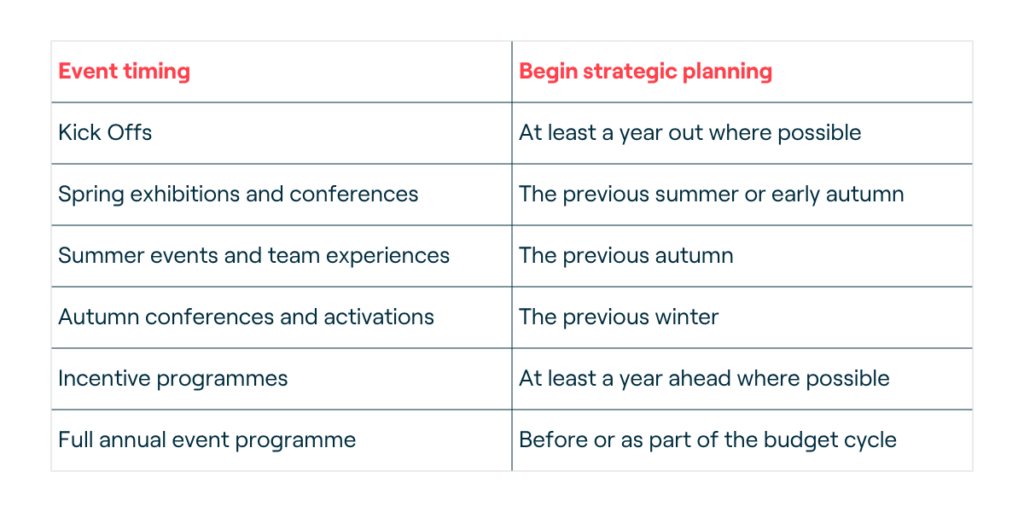
These are guides, not fixed rules. Scale and complexity will affect lead times, and every event, of course, is different.
The principle is simple: to get the best outcomes, map out plans well in advance. (Even if you know they may change a little.)
Measurement should not begin when the event ends.
Decide what success looks like while setting the objective. This allows you to design the experience and follow-up around the evidence and outcomes the business will need to know if and how it worked.
The measures should reflect the event’s role. A customer event might be assessed through qualified opportunities, relationship development and pipeline influence. An internal event may focus more on the qualitative – like employee understanding, confidence or behavioural change. A product experience could measure engagement, adoption or influenced purchases.
Individual results matter, but every programme needs a wider view. One event may create awareness while another deepens the relationship. Looking at each in isolation can hide their combined impact. And that’s not always easy to measure. If you don’t know what you’re trying to achieve at the beginning, you won’t achieve anything meaningful.
Review performance and outcomes throughout the year and use those findings to improve future activity and inform what you need to do next. Solid evidence supports the next strategy and the all-important budget cycle.
The strategy should create the calendar. The results should shape the next one.
2027 is closer than it looks.
If you are beginning to shape your plans, now is the time to step back from individual briefs and consider what the whole programme needs to achieve.
At asembl.group, we bring independent specialists together around your brief, brand and budget. Looking across the full programme helps us connect the right expertise, identify shared opportunities and keep every event aligned with the wider business strategy.
One contact. One contract. One PO.
Looking for a fresh perspective or a strategic partner to support your plans? Talk to us about building your 2027 event programme around what your business needs.
Talk to us about your 2027 event strategy and start planning now.
Before budgets and dates are fixed. Major kick-offs, incentives and international events may need a year or more. Start early to secure greater choice, stronger buying power and more creative freedom.
A clear business objective, a defined audience and the action you want that audience to take. It should also explain the role of each event and how success will be measured.
The calendar tells you what is happening and when. The strategy explains why each event exists. Strategy comes first.
Measure the outcome, not just attendance. Depending on the event, that could mean pipeline influence, stronger relationships, product adoption or behavioural change. Define it before planning begins.

Mark Scales Head of Client Services - asembl.group