What is your event actually worth? Beyond attendance metrics - asembl.group
Blog landing page case study banner – What’s your event actually worth?

A full room looks good in an event report.
So do registrations, leads, footfall and a healthy satisfaction score.

They’re useful numbers. But they answer a fairly limited overarching question: what happened?

Who came. How many. What they did while they were there. Whether they enjoyed it.

Ask most event organisers how their last event performed, and these are the numbers they’ll usually reach for. They’re easy to collect, easy to report and useful indicators of activity.

But they don’t necessarily tell us what the event changed.

Businesses invest serious budgets in live experiences, yet we’re still much better at measuring activity than understanding an event’s lasting impact. And that’s where some of the real value can get missed.

A customer stayed. A relationship moved forward. Someone encountered a product for the third time and finally bought it. A team returned to work thinking differently. A conversation created an opportunity nobody had even anticipated.

Those outcomes are harder to capture in a post-event report. But they’re often where the real value sits.

Activity is visible. Value? Not always obvious.

There’s a reason event reporting gravitates towards the same numbers.  They’re immediate and easy to get your hands on.

Registrations happen before, or sometimes at, the event. Attendance happens at the door. Leads happen on the stand. Feedback lands shortly afterwards.  But true event value doesn’t normally follow the same timetable.

Jody Milton, Co-founder and CEO of Formation Global, makes an important distinction between what happens at an event and the value it goes on to create.

“Three hundred people came to the stand, took a giveaway, had a coffee. That’s activity. Impact is three years later, when one of those people signs a seven-figure contract with you. If you were waiting for the impact before doing another stand, you’d never do another one.”

Of course, nobody would claim that one exhibition stand deserves all the credit for a contract signed three years later.  But it’s also wrong to assume it played no part at all; it almost certainly did.

And that’s the problem with asking an event to prove its worth immediately.  We’re often evaluating a long-term influence at a short-term measurement point.

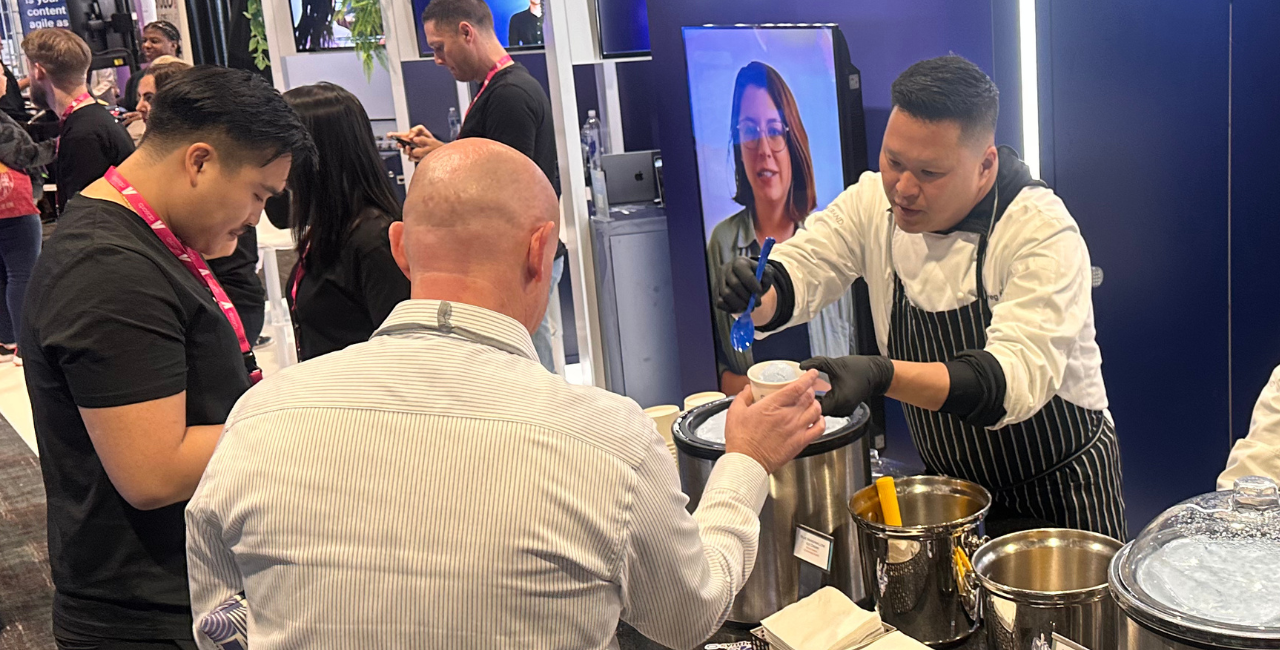
A man in an apron and gloves serves food in cups to two people at a busy indoor event, as attendees enjoying an ice cream on the exhibition stand mingle nearby. A screen behind him displays a woman’s face.

Event value looks different depending on who’s in the room.

There’s another assumption worth challenging.  We talk about the value of an event as though it’s one thing.  It isn’t.

The same experience can create completely different forms of value for different people.

  • A prospect discovers and tries out a product.
  • An existing customer strengthens a relationship.
  • A salesperson learns meaningful insights about the market.
  • An employee feels more connected to the business.
  • A leadership team gets an unfiltered, honest reaction to a new strategy.
  • A conversation creates an opportunity nobody had even seen coming.

Same event. Different people. Different value.

Zoe Light, Head of Agency at asembl., puts it simply:

“Event value is inherently personal. Every attendee takes something different away, so the overarching metric doesn’t really exist. Instead of measuring the event, measure the change. A new perspective. A connection that opens a door.

If someone leaves crediting you for a shift in how they think, you’ve become part of that. If they leave thinking ‘good event, nice catering’, you’ll be outranked by their next good meal out.”

Which is why volume alone can be misleading.

A room of 1,000 people isn’t necessarily more valuable than a room of 100.  Twenty leads aren’t necessarily more valuable than five.  Reach matters. But relevance matters too, as do quality and, importantly, future opportunity.

If the right person has the right conversation at the right moment, the commercial value of that interaction can outweigh hundreds, or even thousands, of passive ones.

The value might not belong to one event alone.

Events rarely exist in isolation. Yet they’re often reported on as if they do.

Rob Goodman, Managing Director at Showplace, sees this clearly through multi-location campaigns.  Showplace delivered a VitrA roadshow across 21 locations in six weeks.

“We didn’t see that as 21 individual events. It was one continuous campaign delivered in 21 different places.”

That distinction matters. In B2B markets, a purchase decision is rarely the result of a single touchpoint. He goes on…

“Somebody meets you at an exhibition and takes no action. They see the brand again months later. Then they meet you at a roadshow and have a proper conversation. The third interaction might be where something happens, but that doesn’t mean the first two had no value.”

Which event created the value?  The first? The last? All three?  Most likely it’s a combination.

In marketing, we know that one interaction rarely leads to a sale. Customers are won and retained through multiple touchpoints that build familiarity, relevance and trust. Live experiences are an increasingly important part of that mix.

Sometimes the value of one event only becomes clear when you stop looking at it in isolation.

A ‘good’ number on paper doesn’t always mean a valuable result.

A busy event can look successful. Strong footfall can feel reassuring. But neither tells you whether the experience actually did the job it was designed to do.

Nick Taylor, Founder and Managing Director of Noba, sees this from the perspective of the connectivity, technology and event intelligence that sits behind the live experience:

“A lot of clients still want to know how many people came through the door on Saturday. We’re trying to shift that to what happened once they were inside: how long they queued, what that cost in revenue.”

Getting people through the door is only part of the job. What matters is what they do once they’re there.

Noba’s work delivering connectivity and event technology for venues and organisers means they see both sides of the picture.   And Nick has a great example of why context matters.

The infrastructure that enables the experience and the data that helps explain what people actually did. Movement, dwell and behaviour can often tell a very different story to a headline attendance or footfall figure. At a venue on London’s South Bank, footfall looked healthy but wasn’t converting. Looking more closely at how people were using the venue revealed why:

“Half of the visitors were only using the venue’s free toilets, because the ones up the road charged. That’s not something a survey was ever going to tell them.”

The footfall figure wasn’t wrong. The assumption being made from it was.

And that’s exactly the point. One number doesn’t need to replace another. Context changes what the numbers mean.

Three women stand outdoors talking and smiling, holding drinks, all wearing event lanyards around their necks, clearly enjoying the experience of connecting at an event.

Not all value is planned.

Events often create opportunities nobody even planned for. And sometimes, that’s where the real value shows.  Rob sees this regularly on roadshows:

“Somebody sees a product demonstrated for one purpose and recognises it solves a completely different problem in their business.”

That wasn’t in the brief or the KPIs, but it could open up an entirely new commercial opportunity.

Jody has seen the reverse. He recalls arriving at an exhibition stand after travelling since early morning, only to find the team had left for lunch.

“You’ve now got no idea who I am. I could have been your biggest buyer that day.”

A useful reminder that 300 interactions aren’t necessarily more valuable than one.

Value isn’t always about gaining more.

We’re naturally drawn to revenue-based outcomes.

  • A lead.
  • A sale.
  • A contact.
  • An opportunity.

But event value can also be protective, forming part of a broader defensive marketing strategy rather than one designed for growth.

  • A customer chooses not to leave.
  • An employee decides to stay.
  • A relationship that had gone quiet gains new momentum…

None of those makes for an exciting headline for the post-event report, but commercially, they are significant.  Sometimes the value isn’t what an event helped you gain. It’s what it helped you keep or even repair.

Value starts with the brief.

If a brief starts with ‘how many people do we want there?’, attendance becomes the measure of success.

If it starts with ‘how many leads do we need?’, leads become the focus.

Both matter. But there’s a better question to ask first: ‘What needs to change because we’re bringing these people together?’

It might be about sales, behaviour, relationships or how people think and feel. Get that clear from the start, and it shapes everything that follows: who needs to be there, what the experience needs to do and the expertise needed to make it happen.

It also shapes what needs to sit behind the experience. Nick sees infrastructure and technology conversations happening too late, once many of the decisions about the event have already been made. Bring that thinking in earlier, and the connectivity, technology and data infrastructure can be designed around what the event actually needs to achieve — rather than retrofitted once the experience has taken shape.

Rob sees the same pattern from a different perspective.

“The best briefs come with a realistic, specific solution. A woolly brief gets a woolly answer, and when that changes, the budget changes and everybody gets upset.”

Jody sees that clarity as fundamental:

“Those who give you sufficient time and information and understand what their outcomes need to be get the best results. There’s no ambiguity.”
So, what is an event actually worth?

There probably isn’t one answer.  Its value might sit in something that happened in the room.  It might emerge six months later.  It might build across several experiences.  It might sit with one high-value attendee rather than 1,000 passive ones.  It might come from an outcome nobody expected.  Or simply from something the business didn’t lose.

That’s why no single discipline sees the whole picture.

Strategy sees one part. Creative another. Physical experience, audience behaviour and repeated brand exposure reveal something else again.

Bringing those perspectives together is central to how asembl.group works: independent specialists assembled around the whole brief, each seeing a different part of the value being created.

Not every event needs every discipline.  But every event benefits from knowing what it’s there to achieve.  So perhaps the question after your next event shouldn’t simply be:

Was it worth it?

Start one step earlier.

What did we mean by ‘worth’ in the first place?

Because until that’s clear, proving it is almost impossible.

If your next event needs to prove more than vanity, send us your brief.

Frequently asked questions.

How should we think about event value beyond attendance and leads?

Start with what the event was designed to change. That might be a commercial outcome, a stronger relationship, a shift in behaviour or perception, or something the business retains rather than gains. Attendance and leads still matter, but they’re only part of the picture.

Why can the true value of an event take time to emerge?

Because events rarely work in isolation. A conversation or experience might influence a decision that happens weeks or months later, or form one of several touchpoints that eventually lead someone to act. The event still created value, even if the outcome wasn’t immediate.

Should every event be judged on its own?

Not always. Events often sit within a wider customer journey, campaign or relationship. A roadshow, exhibition or brand experience might build familiarity and trust that only pays off after several interactions. Looking at each event in isolation can miss that cumulative value.

When should you define what event success looks like?

Before you start designing the event. Ask what needs to change because we’re bringing these people together. That gives the brief a clearer purpose and helps shape the audience, experience, format and expertise needed to deliver it.

Does a bigger event create more value?

Not necessarily. More attendees, leads or interactions can be positive, but volume alone doesn’t tell you how valuable they were. One conversation with the right person can create more commercial value than hundreds of passive interactions.  It should always be about defining what outcomes are needed ahead of planning and building the event to deliver them.

How does asembl.group approach event value?

We look at the whole brief. By bringing together independent specialists across strategy, creative, live experience, exhibitions, connectivity and more, we can consider value from different angles and build the right expertise around what the event needs to achieve.

Contributors.

Jody Milton

Jody Milton CEO & CO-Founder - Formation Global

Zoe Light 1

Zoe Light Head of Events - asembl.

Rob Goodman

Rob Goodman Managing Director - Showplace

Nick Taylor

Nick Taylor Director - Noba